New year, new rules: the key payroll changes for 2025
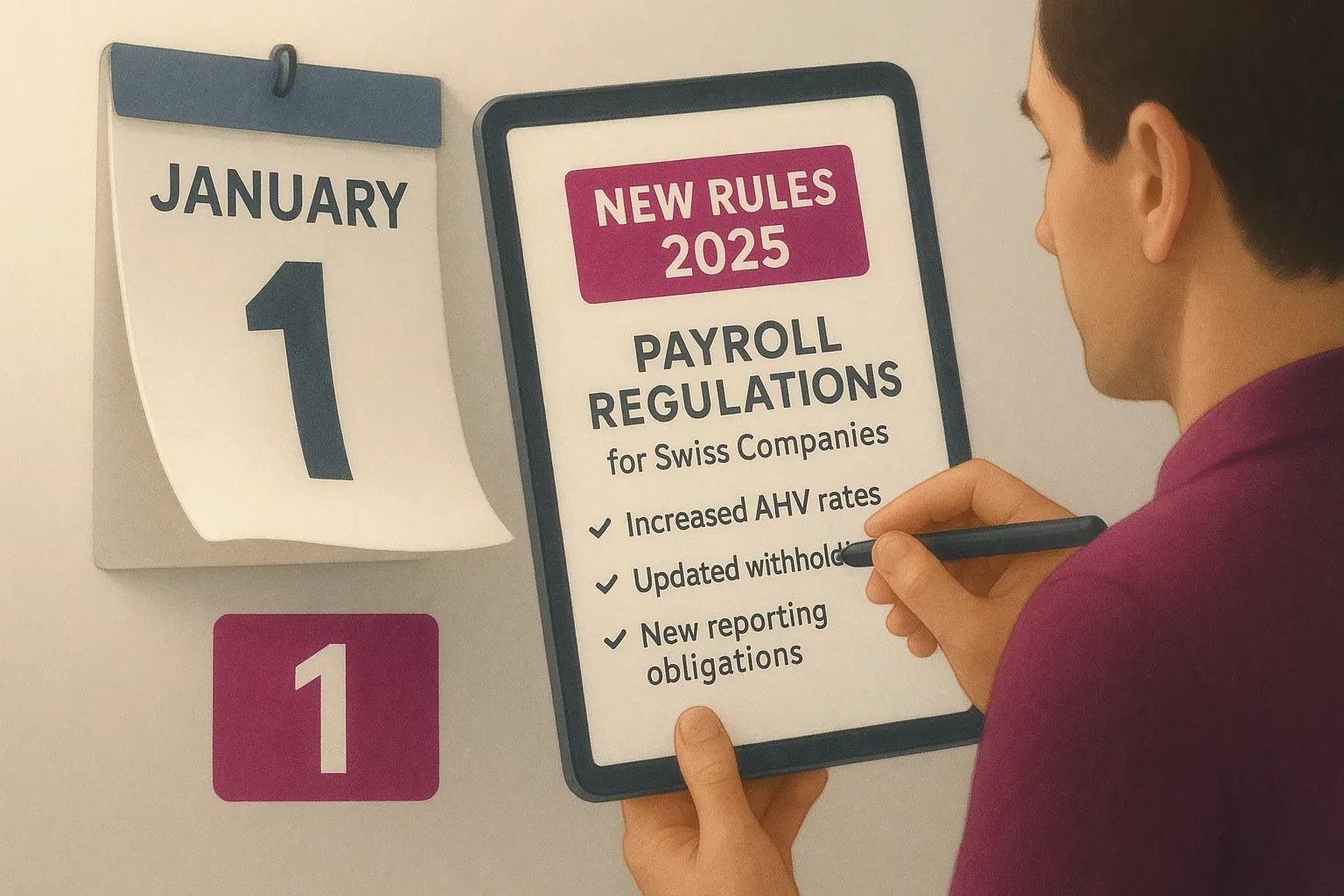
2025 brings some important changes for employers and their employees. From adjustments to AHV and BVG and a new threshold for small salaries to more digital processes in social insurance: in this article, we look at the key changes and share practical tips on how to prepare as an employer.
Social insurance: new maximum AHV pension and adjusted thresholds
At the turn of the year, the maximum AHV (old-age and survivors’ insurance) pension rises. As a result, the thresholds that matter for the BVG (occupational pension) change too. The minimum AHV contributions, the limits of the sliding contribution scale for the self-employed and the contributions for non-employed persons are also raised, following the familiar system.
Small salaries: new exemption limit of CHF 2,500
From 2025, the exemption limit for small salaries is CHF 2,500 instead of CHF 2,300, per calendar year and employer. In practice, this means social insurance contributions on salaries below CHF 2,500 only have to be deducted if the employee expressly asks for it. If you employ people in this range, adjust your payroll accordingly and let them know.
Women’s retirement age: the first step
In 2025, the first step towards aligning the women’s retirement age with men’s takes effect. Women born in 1961 now reach the reference age at 64 years and 3 months. Informing and advising the employees concerned in good time avoids uncertainty and helps with workforce planning.
BVG figures and what they mean for the second and third pillars
Coordination deduction and entry threshold
- The coordination deduction is now set at CHF 26,460.
- The entry threshold rises to CHF 22,680.
- The BVG minimum interest rate stays at 1.25%.
Higher pillar 3a contributions and back payments
- With a second pillar, a maximum of CHF 7,258 can be deducted for tax purposes from 2025.
- Without a second pillar, the maximum is CHF 36,288.
- Unused 3a contributions can now be paid in retroactively for up to ten years. This takes account of individual fluctuations in contributions and further strengthens the three-pillar system.
It’s worth pointing employees to these options, because flexible pension arrangements are often an attractive part of a compensation package.
Child allowances: higher minimum amounts
Family allowances change too:
- The child allowance rises to at least CHF 215 (+CHF 15).
- The education allowance rises to CHF 268 (+CHF 18).
These changes affect monthly payslips. Make sure your payroll software is updated in time.
Retiree allowance: the choice runs to the end of the year
Employees who have reached the reference age can set their retiree allowance afresh each year (until the first payroll run of the following year). They only need to tell you again if they want to change a choice they have already made. There is no legal duty to inform them, but telling employees in good time can prevent misunderstandings.
Private use share for electric vehicles: a change of system in social insurance
From 2025, important changes apply when employees use electric vehicles, especially if the employer also pays for a wallbox at the employee’s home. Until the end of 2024, all costs (installation included) were counted in the private use share. From the new year, social insurance law takes a new approach: installation costs now count as salary subject to contributions and are no longer added to the private use share.
So it’s worth reviewing all private use shares set by 31 December 2024 and, where needed, correcting them downwards retroactively. It is also essential to show the one-off installation costs correctly on the payslip in the month they are actually incurred. That way, employers meet every requirement and avoid uncertainty with social insurance.
Limits on flat-rate representation expenses
The updated model regulations of the Swiss Tax Conference (SSK) now cap flat-rate representation expenses:
- A monthly amount above CHF 500 may be no more than 5% of gross salary.
- There is also a ceiling of CHF 2,000 per month.
If the flat rate exceeds these limits, the excess is no longer covered by an approved expense policy, and the tax authority may add it to taxable income. All flat-rate expenses must still be shown in box 13.2 of the Lohnausweis (salary certificate). With an approved expense policy, the corresponding note goes in box 15.
Digital social insurance
A significant step towards less red tape: from 2025, claims for EO (income compensation) can be filed online. Paper forms are being phased out step by step. This takes load off employers and insured persons alike. To keep things running smoothly, check your internal processes and software integrations early.
What to do
Check your software settings: make sure your payroll and accounting software reflects the new thresholds and changes correctly at the turn of the year. In particular:
- New thresholds for small salaries and child allowances, and the BVG entry threshold and coordination deduction.
- The switch to the new system for electric vehicles for employees with a company car.
- An updated expense policy and the correct handling of flat-rate representation expenses.
Further recommendations
- Inform employees: a short information session or a circular at the start of the year helps you communicate the key changes clearly.
- Review retirement planning: with the women’s retirement age changing and retiree allowances to choose, it’s worth training your HR team to advise employees.
- Update your expense policy: if you haven’t already, review your expense policy and, where needed, submit it to the cantonal tax office for approval.
Conclusion
2025 brings employers a number of changes in social insurance and payroll administration. Engaging with the new rules early, adjusting your software and communicating openly with employees make the transition easier. That way, your company is set up correctly, both legally and organisationally, and you show that you are a modern employer that thinks ahead.