Mandatory social insurance in Switzerland: an overview
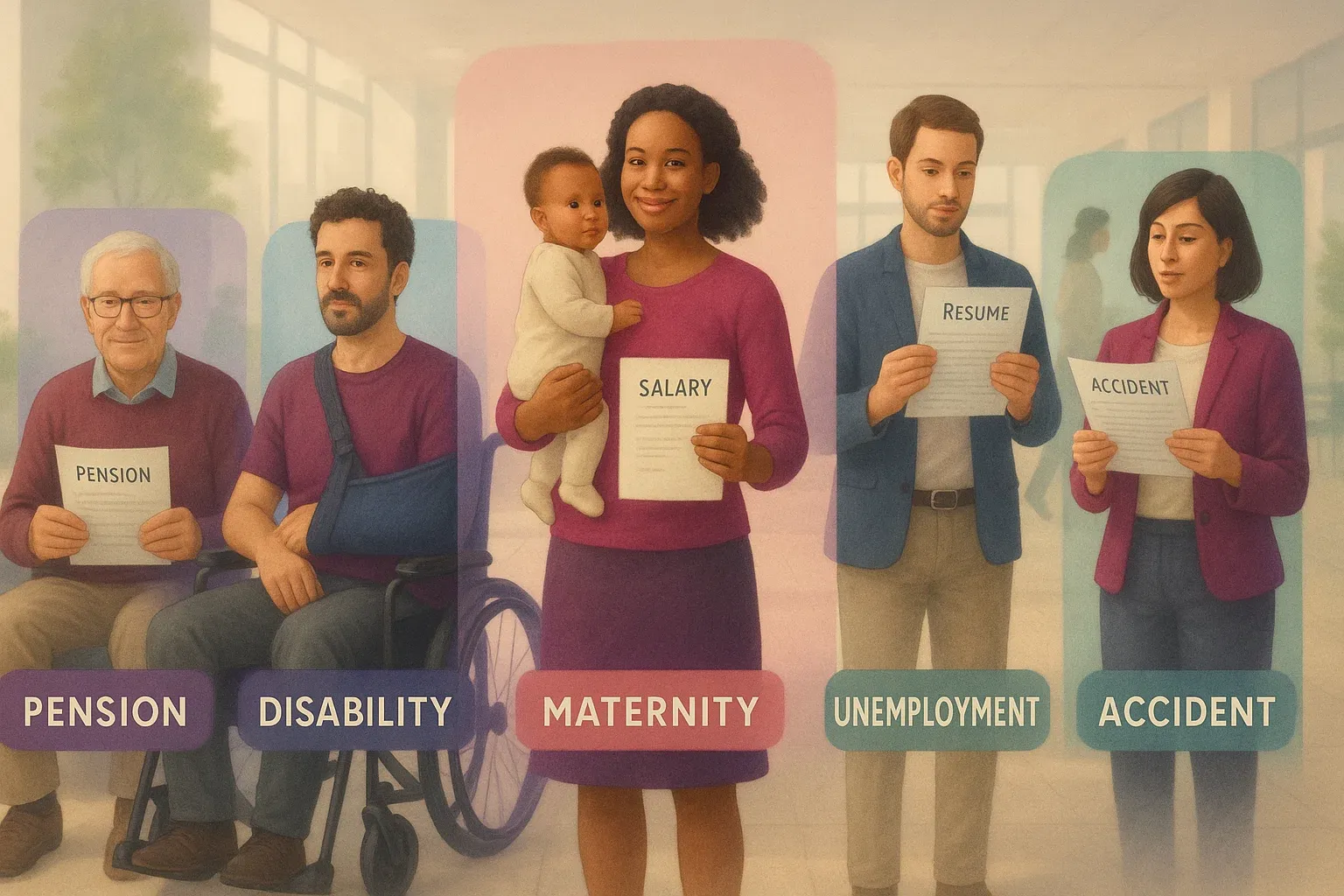
As an employer in Switzerland, you deal with many topics day to day. Social insurance is one of them. It is the backbone of the Swiss social system and gives people security in very different situations in life. For employers, it is more than a legal requirement: it is a key part of fairness and transparency in every employment relationship.
To help you keep track of the main points, here is a compact guide to mandatory social insurance. If you are also interested in voluntary cover, take a look at our separate article on better benefits.
Mandatory and voluntary social insurance in brief
The Swiss social insurance system rests on three pillars. Two are required by law, the third is voluntary. For you as a company, the key question is which insurance you must take out and which is optional, so that your employees are well covered.
Since we focus on mandatory insurance here, it’s worth mentioning briefly that voluntary options exist alongside it, such as certain supplementary accident insurance or extended BVG solutions. You’ll find more on these in our article on better benefits.
Below, we look in detail at the mandatory insurance in Swiss HR: AHV/IV/EO and ALV, accident insurance and occupational pension (BVG).
AHV/IV/EO and ALV
AHV (old-age and survivors’ insurance), IV (disability insurance) and EO (income compensation), together with ALV (unemployment insurance), are central building blocks of the Swiss social insurance system. In principle, all employees between 18 and 64/65 pay contributions. Once they reach the reference age (64 years and 3 months for women, 65 for men; as of 2025), ALV contributions stop entirely, while AHV/IV/EO grants a monthly allowance of CHF 1,400 that stays free of contributions. Contributions are settled through the compensation offices (Ausgleichskassen). They send advance invoices during the year and ask for a year-end declaration by the end of January of the following year. The final invoice for employee and employer contributions is based on it.
The statutory contribution rates (as of 2025) are 10.6% in total for AHV/IV/EO and 2.2% for ALV, calculated on the relevant salary (massgebender Lohn). Employer and employee each pay half. On top come FAK (family allowances) and administrative costs, which the employer pays in full and which can vary by canton or sector.
To follow how contributions are calculated, you need to know which salary components are subject to them. Together they make up the relevant salary. A useful reference is the guidelines on the relevant salary (WML), available here: WML: Bestimmung des massgebenden Lohnes (in German).
AHV/IV/EO has no salary ceiling, while for ALV, salary above CHF 148,200 a year (or CHF 12,350 a month) is no longer subject to contributions. Employees in a position similar to an employer’s are a special case. They pay ALV contributions, but have no claim to ALV benefits if they become unemployed, because they can significantly influence the company’s decisions.
Accident insurance
UVG (accident insurance) is also mandatory in Switzerland. From their first working day, all employees must be insured against occupational accidents. Employees who work more than eight hours a week must also be insured against non-occupational accidents. The employer pays the premiums for occupational accident insurance, while those for non-occupational accidents are usually paid by the employee. The employer can, however, choose to pay these premiums too.
In the event of an accident, salaries are insured up to CHF 148,200 a year (or CHF 12,350 a month). Supplementary insurance can cover higher salary shares. Whether SUVA is responsible automatically or a private insurer can be chosen depends on the sector and the legal rules. When a claim is made, accident insurance pays a daily allowance of 80% of the insured salary from the third day, until the person can work again or an accident pension is claimed. Accident daily allowances are not part of the relevant salary, so no AHV/IV/EO/ALV contributions are due on them.
Occupational pension (BVG)
BVG (occupational pension) is the second pillar of Swiss retirement provision. Together with AHV/IV, it aims to maintain the accustomed standard of living in old age or in the event of disability. Employees are insured against the risks of disability and death from 1 January after their 17th birthday, and for retirement benefits as well from 1 January after their 24th birthday. Mandatory BVG covers an annual salary between CHF 22,680 and CHF 90,720. Subtracting the coordination deduction (CHF 26,460) gives the coordinated salary, which is at most CHF 64,260.
There are three exceptions in which no BVG obligation applies:
- The employee has not yet reached the entry age for occupational pension, or is already past retirement age.
- The employment contract is fixed-term and lasts no more than three months.
- The employee is at least 70% disabled within the meaning of IV.
Employers with employees subject to BVG must be affiliated with a registered pension fund. A salary above the upper BVG limit can be insured through supplementary solutions. BVG contributions are usually charged as fixed contributions, and employer and employees share the cost of occupational pension.
Conclusion
Mandatory social insurance in Switzerland is varied and can look complex at first. Yet it gives your employees important cover in case of illness, accident, disability, unemployment and for old age. For you as a company, what matters is meeting the legal requirements and knowing the administrative steps, especially contribution settlement, declarations and deadlines.
If you want to look more closely at voluntary insurance or extended pension solutions, get further advice or read our article on better benefits. It shows how you can give your employees security beyond the legal minimum. That makes your company a more attractive employer and makes a real contribution to your employees’ long-term security.